Some links in this post are affiliate links. If you book through them, we earn a small commission at no extra cost to you. It helps us keep making free guides and videos.
We'd heard so many good things about Sri Lanka, and dreamt of going for years. It's a small, teardrop-shaped island off the coast of India, yet it's overflowing with culture, colour and character: warm, generous people, bold food, and landscapes that change every few hours, from misty tea fields to golden beaches to jungle full of wildlife.
Our trip was planned by India Someday, an agency we'd followed on Instagram for six or seven years. They booked our stays and our driver and hosted us, and in return we're sharing exactly how it went. This is our two-week loop from Colombo through the Cultural Triangle, the hill country and Yala, then down the South coast: what we loved, what we'd skip, and what we'd tell a friend before they go.
Free download: our Essential Sri Lanka Guide covers the new free ETA, the online arrival card, the two monsoons, drivers vs trains and real costs in three pages. Grab it before you book anything.
Watch the full trip on our YouTube channel →
Our two-week Sri Lanka route at a glance
Colombo (2 nights): a jungle hotel, the Red Mosque, a street-food tour and Galle Face Green
Sigiriya (2 nights): the Dambulla cave temple, Lion Rock at sunrise and wild elephants
Kandy and tea country (1 night): a tea-estate lodge, the botanical gardens and a tea factory
Ella or Haputale (2 nights): the famous train ride and the Nine Arches Bridge
Yala (2 nights): a jungle lodge and safari, the highlight of our trip
The South coast (4+ nights): Hiriketiya, Weligama, Ahangama and Hikkaduwa
We flew into Colombo and out again, and the whole loop works with a private driver plus one unforgettable train ride. Go between December and March for the South and West coasts: that's when they're dry.
Colombo: don't skip it
Landing was smooth: we had our ETAs sorted before we flew, immigration took five minutes, and our driver was waiting with a welcome sign. A lot of people skip Colombo. We're so glad we didn't.
We stayed two nights at Aathma Colombo House, honestly one of the most beautiful hotels we've ever stayed at. It's a jungle hideaway on a lake, with squirrels and birds everywhere, a pool and a private balcony with a jacuzzi. We'd fly back to Colombo just to stay here again. Our first dinner was the traditional Sri Lankan rice and curry: a huge spread of little dishes, plus a ginger and coriander chicken curry. What a start.
The next day we visited the Independence Memorial Hall, wandered the colonial Fort area with its cafés and boutiques, and went inside the candy-striped Red Mosque in Pettah market. Built in 1908, it's one of the most photographed buildings in the country, and the free tour (they lend you a gown) was a calm break from the chaos of the market outside.
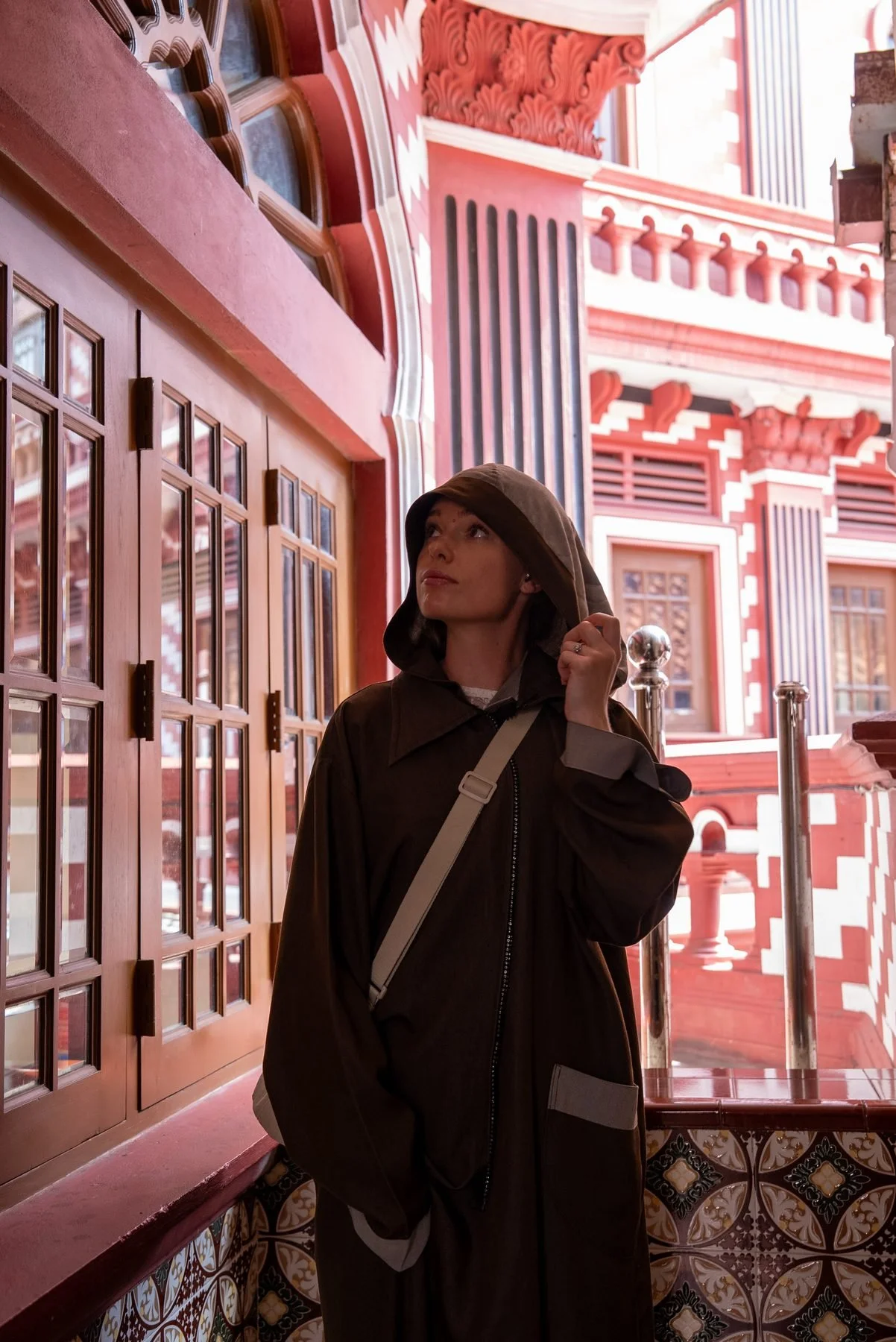
Inside the Red Mosque in Pettah. They lend you the gown.
In the afternoon we did a street-food tour, the Colombo Food Coma with Sensory Indulgences. Highlights: mutton rolls (one of the best things we ate all trip), a fiery shot of arrack (somewhere between rum and whisky) at a microbrewery, then Galle Face Green at sunset, where Rhett joined a game of cricket and we ate chilli mango, cassava chips and bombai muttai. We ended with kottu roti, the national chopped-flatbread stir-fry, and an ice cream.
Our tip: give Colombo two or three nights. It has a really cool food scene, and it's a gentle way to start. For drinks, Claire's map has Park Street Mews, a lively street for an evening out.
Sigiriya: Lion Rock and wild elephants
From Colombo it's about four hours by car to Sigiriya, through villages and tropical forest. On the way, stop at the Dambulla Cave Temple. We didn't know what to expect, and it blew us away: caves full of Buddha statues and intricate paintings. Cover up properly, including your midriff and knees.
We stayed at Kumbukgaha Villa, which felt like being on safari in Africa: peacocks flying overhead, wild elephants roaming nearby and a pool to cool off in. If you want luxury, Claire pinned Jetwing Vil Uyana near Lion Rock.
The next morning we were up at 4 am for Sigiriya Lion Rock, a UNESCO site with a citadel built by a king 1,500 years ago on top of a giant rock. It costs $35 each, and the climb takes about half an hour. It's very steep, and nobody tells you how high it is, so if you're scared of heights, be warned. Watching the sunrise from the top, looking over the jungle canopy, is one of the most peaceful things we've ever done.
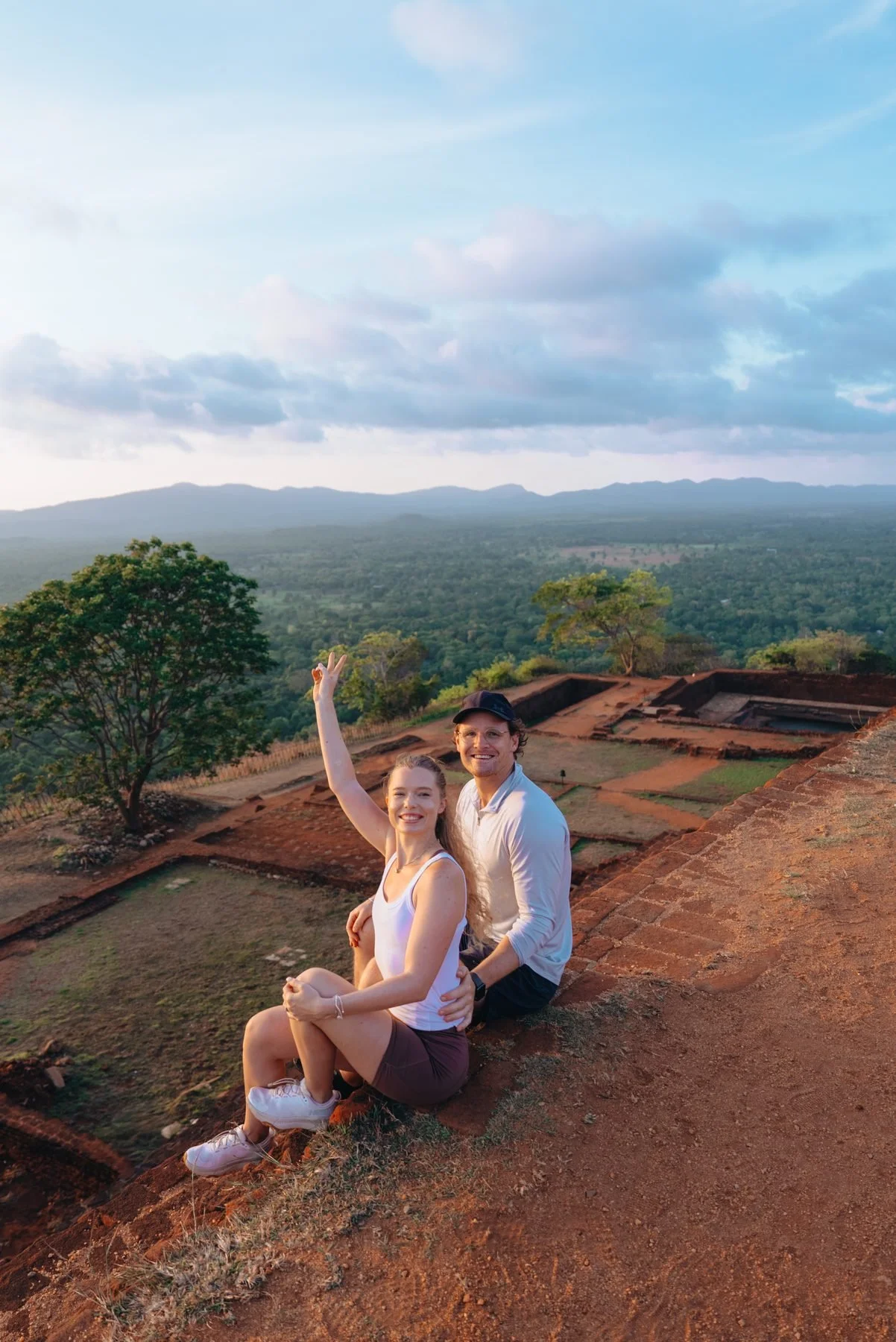
At the top of Lion Rock. Worth the 4 am alarm.
That afternoon we did a village tour (a river boat ride, making coconut sambol, threshing rice and weaving palm leaves), then a safari in Minneriya National Park. Entry was about $35 each, and the jeep and driver about $40. There were so many elephants. Honestly, there were also a lot of jeeps, more than we've seen in any park, and we wish the park limited them. The elephants seemed relaxed, but it's worth knowing before you go.
Our tip: for a quieter view, climb Pidurangala Rock next door. Claire's note on our map: far fewer crowds, and full views of Lion Rock itself.
Kandy and the tea country
From Sigiriya it's about three hours to Kandy on winding roads. We didn't stay in the city itself but at Madulkelle Tea and Eco Lodge, a hidden gem on a tea plantation about 1.5 hours away. It's a mission to get to, but the views are insane: cute glamping tents, an infinity pool over the mountains, and cool air at around 1,000 m. Rather sleep in town? Kandy Myst by Cinnamon and The Radh Hotel are both on our list.
In Kandy we loved the Royal Botanical Gardens (60 hectares of giant trees from all over the world) and the viewpoint over Kandy Lake. The Temple of the Tooth is one of the most important Buddhist sites in the world, said to hold the Buddha's tooth. Honestly? It's a good visit if you're into Buddhism, but we could have skipped it.
On the way to the train we stopped at Bluefield Tea Factory for a quick tour. We had no idea how involved tea-making is, and one of the machines is over 100 years old and from Belfast, where Claire's family is from. Then we had the strongest cup of tea of our lives.
The train to Ella, and the Nine Arches Bridge
Why take a train if you have a driver? Because the ride is the attraction. We boarded at Nanu Oya and rode two to three hours through tea plantations and misty mountains. It's busy with tourists, so book reserved seats on 12Go as early as you can, or ask your agency. Claire's map note: start in Nuwara Eliya (or Kandy) and end in Ella for the best views.
Our agency put us in Haputale, a quieter, more local alternative to Ella, at Nilowin Glenanore Guesthouse, with tea fields right behind it and a home cooking class. If you stay in Haputale, go to Lipton's Seat for sunrise.
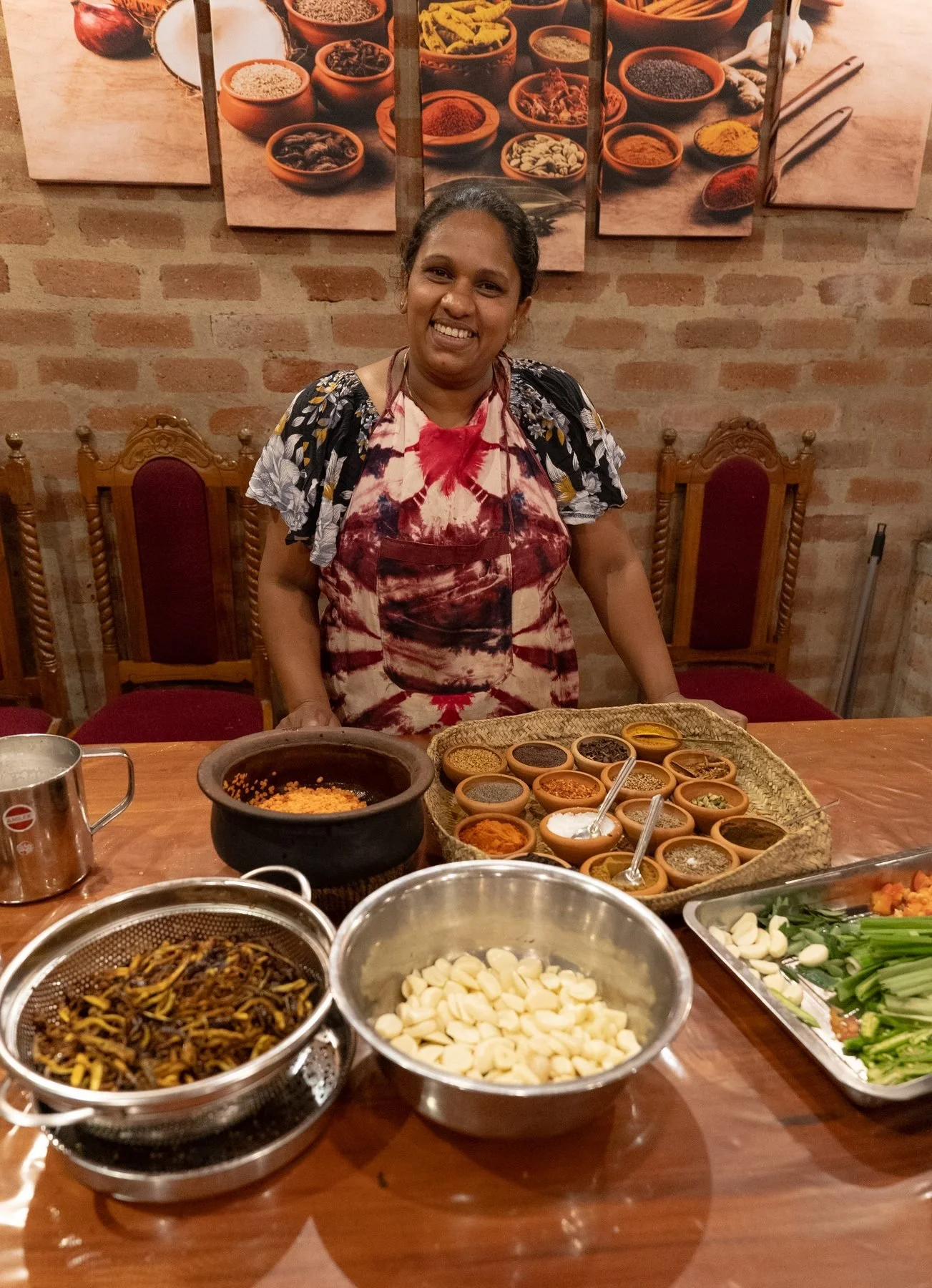
Our home cooking class at the guesthouse in Haputale.
Then we went to Ella for the Nine Arches Bridge: a beautiful 15-minute walk through the forest past rice fields, then the bridge itself, built in 1921 and about 24 m high. It was less stressful than we expected. Walk down the stairs to the tea plantation below for the best view. Afterwards we had smoothie bowls and a burger at Cafe Chill in Ella town (after ten curries in a row, we needed it).
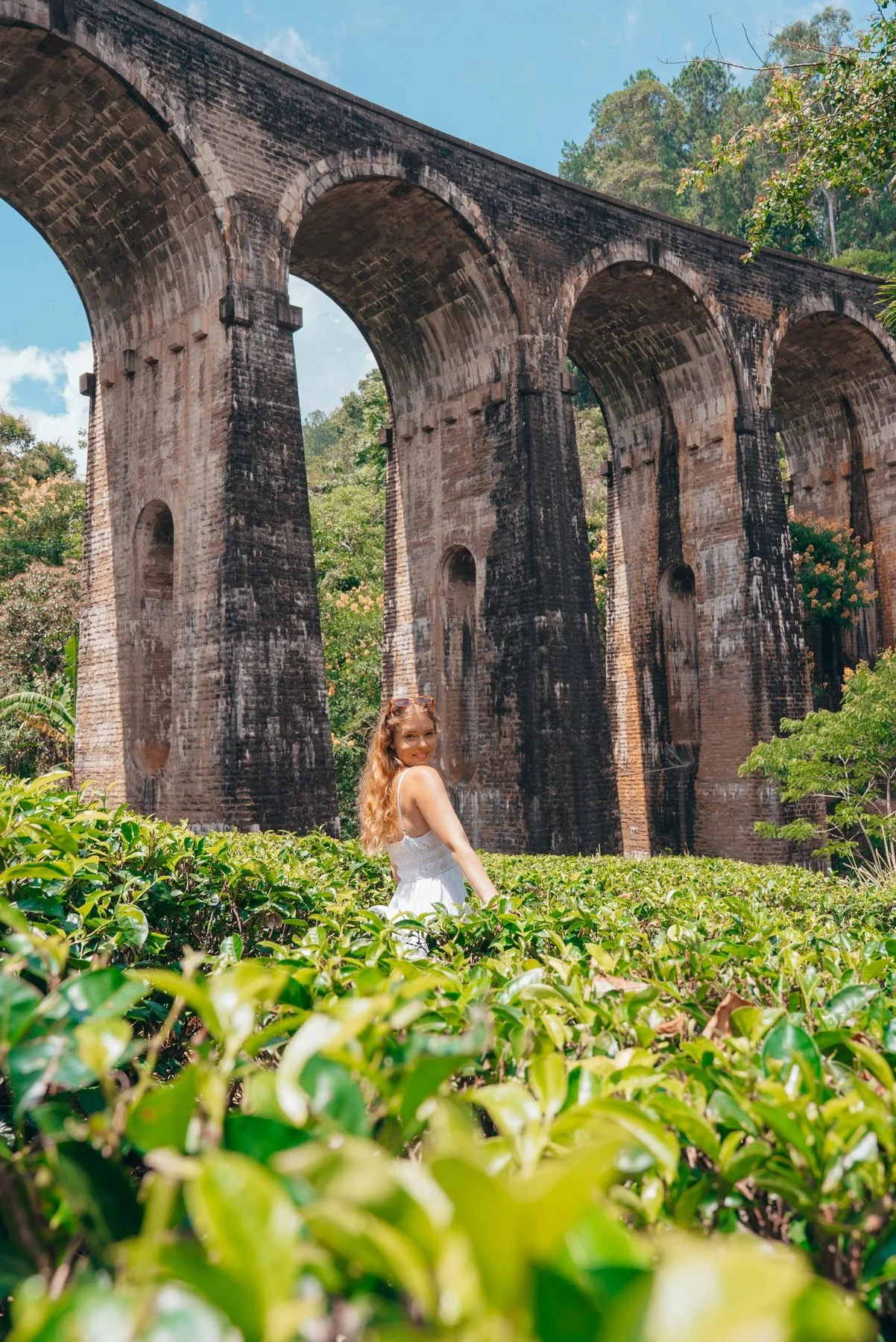
In the tea fields below the Nine Arches Bridge.
Our tip: we'd stay in Ella next time, not Haputale. Yes, it's busier, but for a reason: more cafés, waterfalls, better stays and the bridge within walking distance. It has an Ubud, Bali vibe. Wild Resort Ella and Country Homes are on our list.
Yala: the highlight of our trip
From the hills we drove down to Yala and spent two nights at Treetops Jungle Lodge. It was the highlight of our whole trip: a real jungle lodge where elephants wander through camp. Yala National Park is famous for leopards, as well as elephants, crocodiles and incredible birdlife. Book your game drives through your lodge.
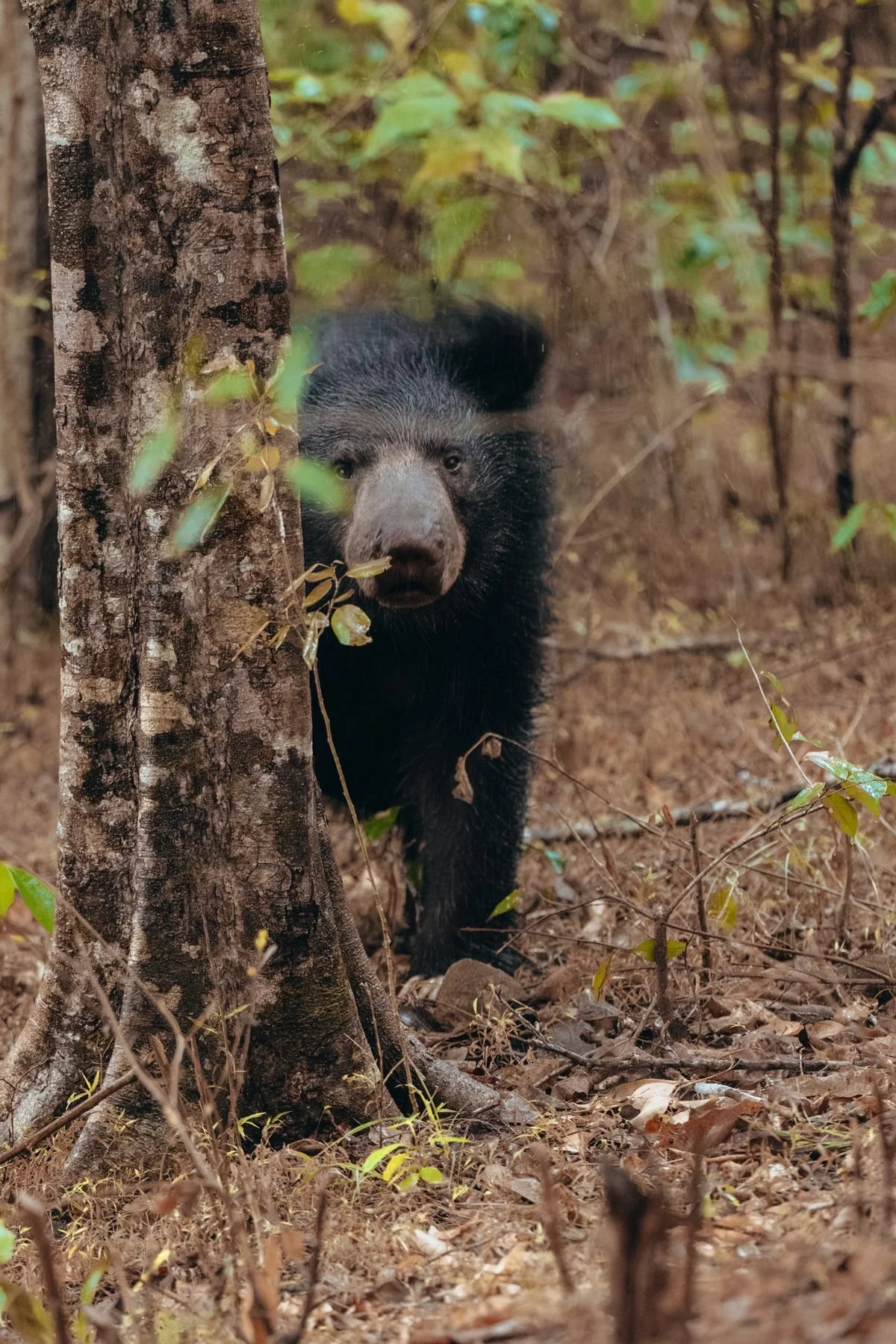
Our sloth bear sighting in Yala. Baloo from The Jungle Book in real life.
Want something more luxurious? Wild Coast Tented Lodge and Cinnamon Wild Yala are both close to the park.
The South coast: Hiriketiya, Weligama and Ahangama
Our first beach stop was Hiriketiya, and we fell in love with it. It reminded us so much of the old Bali: a horseshoe bay, surfers, yoga shalas, cosy cafés and boutique stays. We stayed at The Yard, a bohemian spot 100 m from the beach with a shared kitchen and yoga mats. People come for a few days and stay for weeks. We wish we had.
An hour along the coast, Weligama is one of the best places in the country to learn to surf. We had our lesson with Ama Surf School, who were great, and it cost about $20 for 75 minutes, board included. Got work to do? Outpost is a good digital nomad spot with good internet. We stayed at Eraeliya Villas & Gardens, our own villa in a tropical garden on a quiet stretch of beach, with a huge stone bath and a floating breakfast in the pool. It rained for most of our stay, so we're glad it was a place we were happy to stay in.
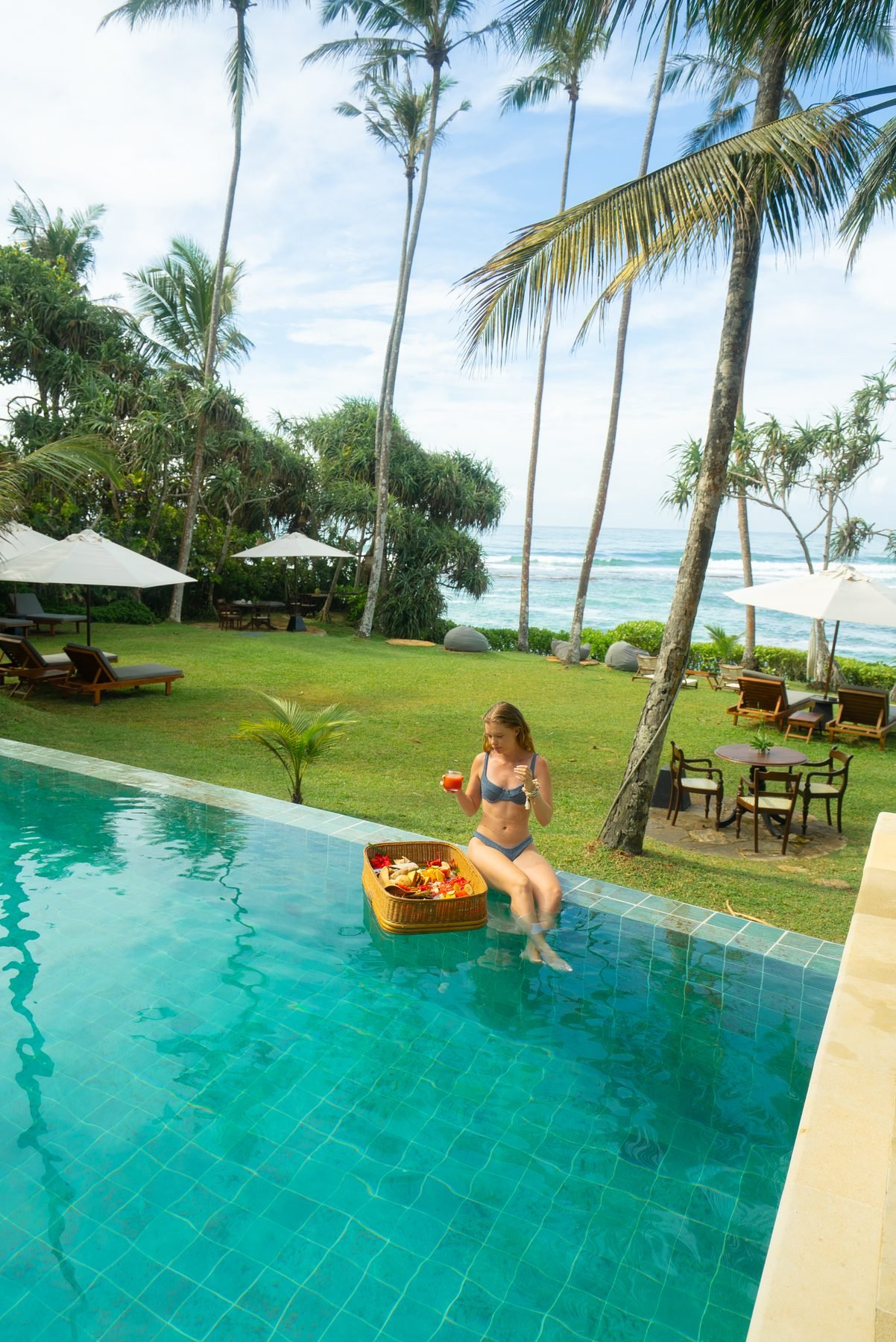
The floating breakfast at Eraeliya, in Weligama.
In Ahangama we stayed at Abode by the Beach, with a bathtub on the balcony overlooking two sandy beaches, and guests can use the pool at Abode Ahangama. We café-hopped from KAI to Cactus (Claire's favourite in Ahangama) and Hakuna Matata for ginger beer and curry. On our way out we stopped at the Rasta rope swing, ten minutes away. It's one of the best things we did.
Our last stop was Hikkaduwa. Honestly, it didn't leave the best impression in shoulder season: the sea was choppy and murky and lots of places were closed. But Tropical House Jungleside Villa turned out to be one of our favourite stays of the trip, and it's handy for the airport. In season, snorkel with turtles at Turtle Beach.
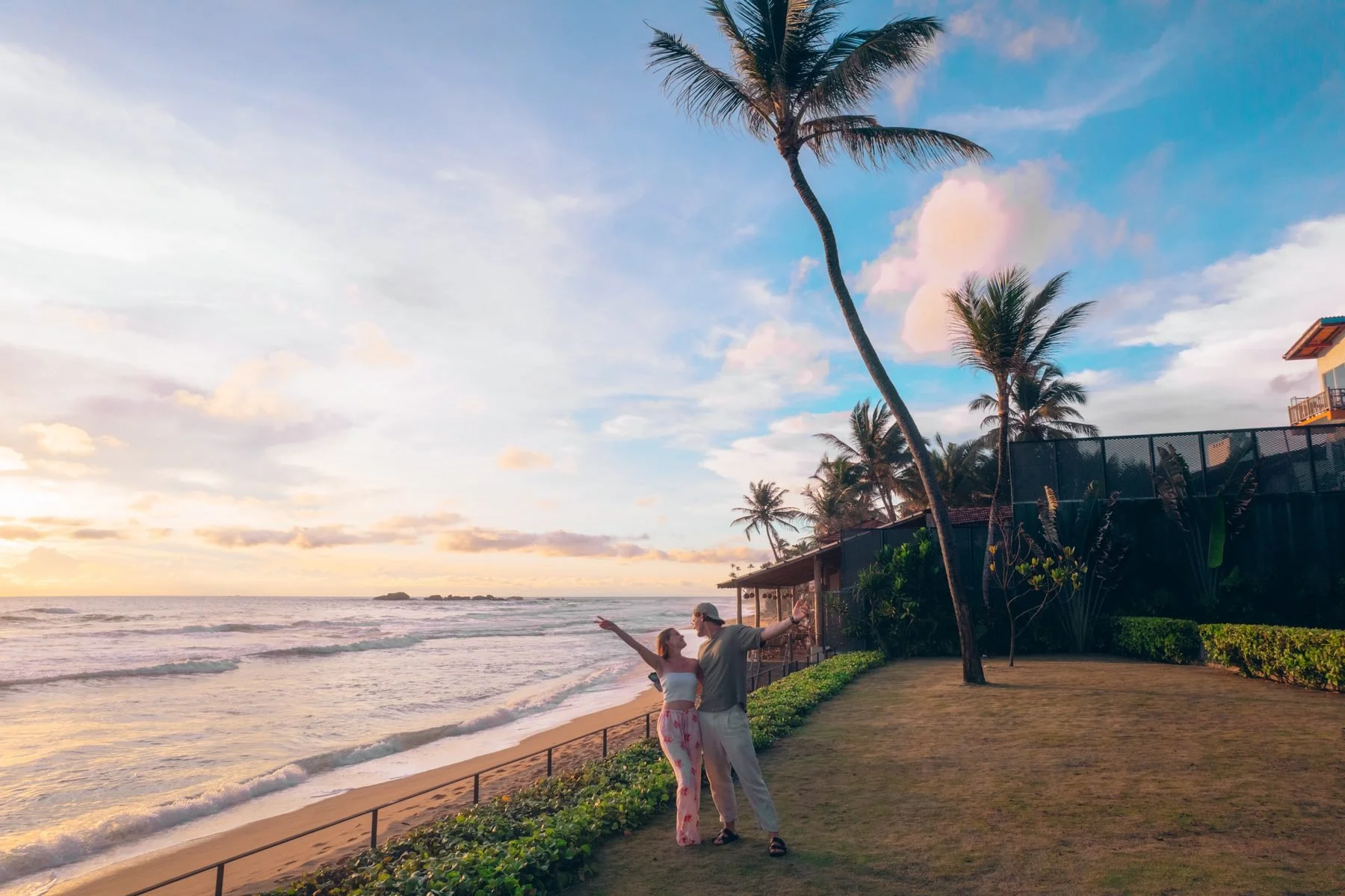
Sunset on our last evening in Hikkaduwa.
Want our exact plan?
We've put everything from this trip into our Sri Lanka Destination Guide: the 14-day route day by day (plus a beach-first version), our Google Map with 100+ places Claire pinned along the way, 70+ hand-picked stays, a booking timeline and what things cost.
The people and tours we'd use again:
India Someday to plan your route, driver and stays
Our GetYourGuide picks for tours and entry tickets
Best time to visit Sri Lanka
Sri Lanka has two monsoons. For the South and West coasts (and this route), go from December to March. From May to September, the South-West gets the rain, which is when the East coast has its season. We went back in 2026 to do exactly that, and we'll be sharing that East coast trip on the channel and here on the blog soon. We went in shoulder season and got a lot of rain on the South coast, so it really does matter.
How to get around Sri Lanka
A private driver is the easiest way to do this route: distances look short, but roads are slow and the driving is chaotic. Add the hill-country train for the views, and use the PickMe or Uber app for tuk-tuks so you pay a fair price. If you want to rent a tuk-tuk yourself, you'll need an International Driving Permit plus a local licence (tuktukrental.com sorts it).
Packing essentials
Clothes that cover your shoulders and knees for temples, plus a sarong
A warm layer for the hill country: it gets cool up there
Strong mosquito repellent and a rain jacket
An eSIM like Holafly (code RHETTANDCLAIRE) for maps and the ride apps
Travel insurance. We've used SafetyWing for six years. Tuk-tuk bumps, upset stomachs and cancelled flights all happen.
Final thoughts
Nobody talks about how lush and full of life Sri Lanka is: animals, birds, trees and plants everywhere. In two weeks we climbed an ancient citadel at sunrise, rode one of the world's most beautiful trains, watched elephants walk through our camp and surfed on the South coast. It's an island that slows you down and surprises you at every turn.
Start with our free Essential Sri Lanka Guide, and if you want the whole trip planned for you, our Sri Lanka Destination Guide has the route, the map and the stays. Ayubowan!