The Ultimate guide to The Serengeti
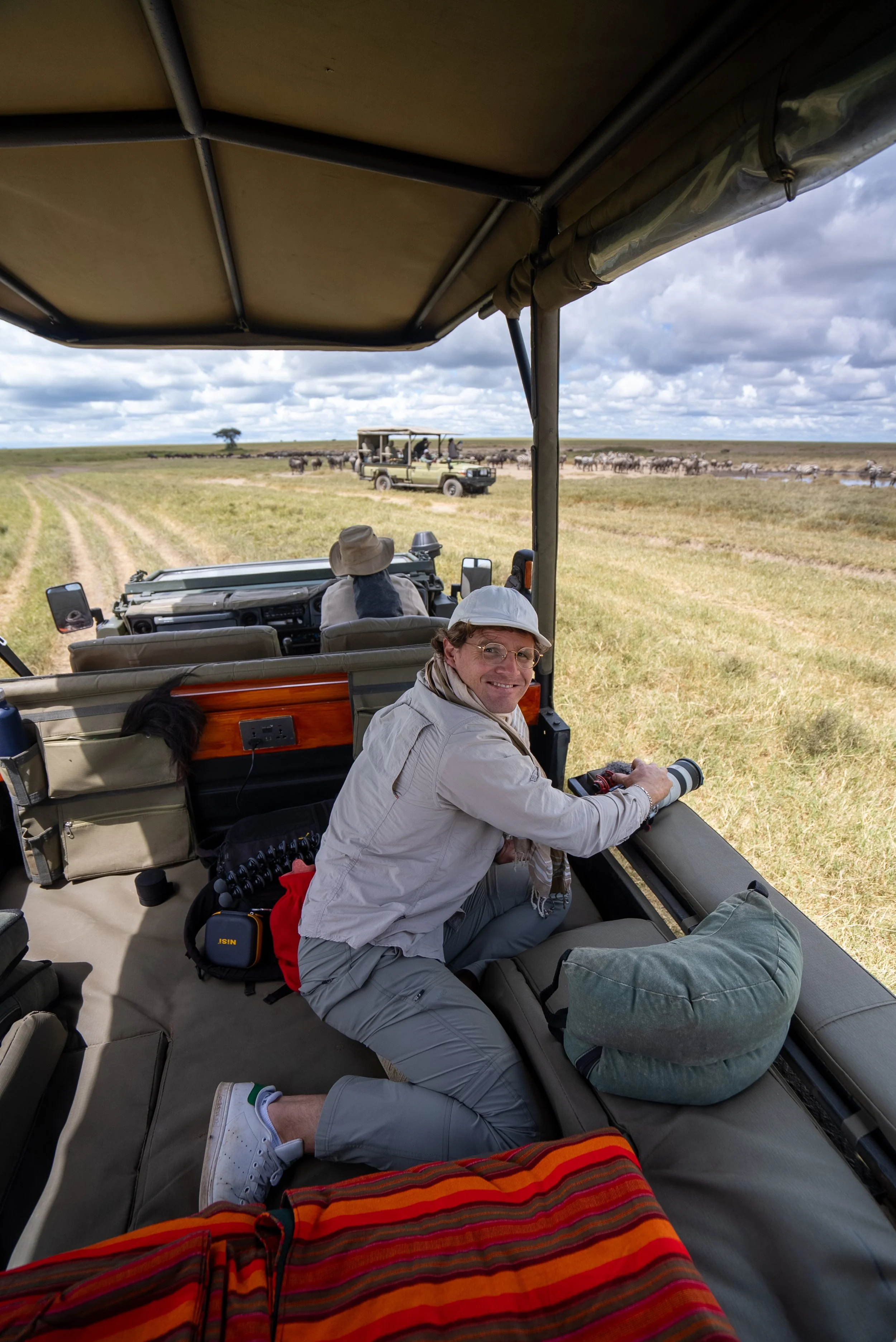
Few places live up to their reputation quite like the Serengeti.
Stretching across roughly 1.5 million hectares of protected savannah in northern Tanzania, Serengeti National Park forms the heart of a much larger ecosystem shared with Kenya’s Maasai Mara. It is home to an extraordinary concentration of wildlife and hosts the annual movement of vast herds of wildebeest, zebra and gazelle in search of fresh grazing and water. UNESCO describes it as the largest remaining unaltered animal migration in the world.
But the Serengeti is about far more than the Great Migration.
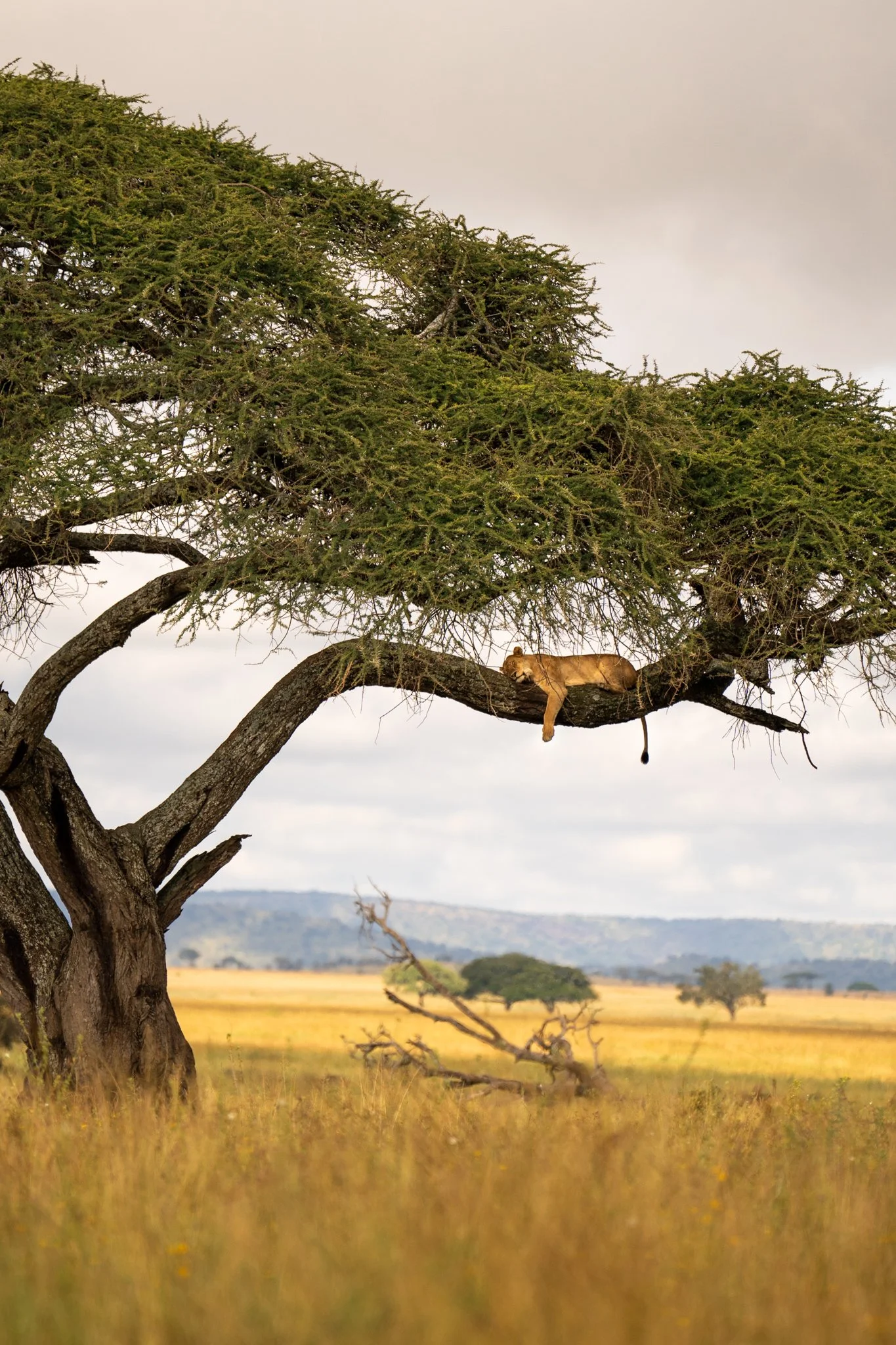
This is a place of open plains, rocky kopjes, acacia woodlands, river valleys and resident wildlife that remains here throughout the year. Lions rest in the shade beside the road, cheetahs scan the grasslands from termite mounds, elephants move between the trees and giraffes sometimes wander directly through camp.
In this guide, we cover everything you need to know before visiting the Serengeti, including the best time to go, where to stay, how long you need and what a safari here is actually like.
This article was created in partnership with Viatu and Entara, whose camps and lodges formed part of our journey through Tanzania.
Where is the Serengeti?
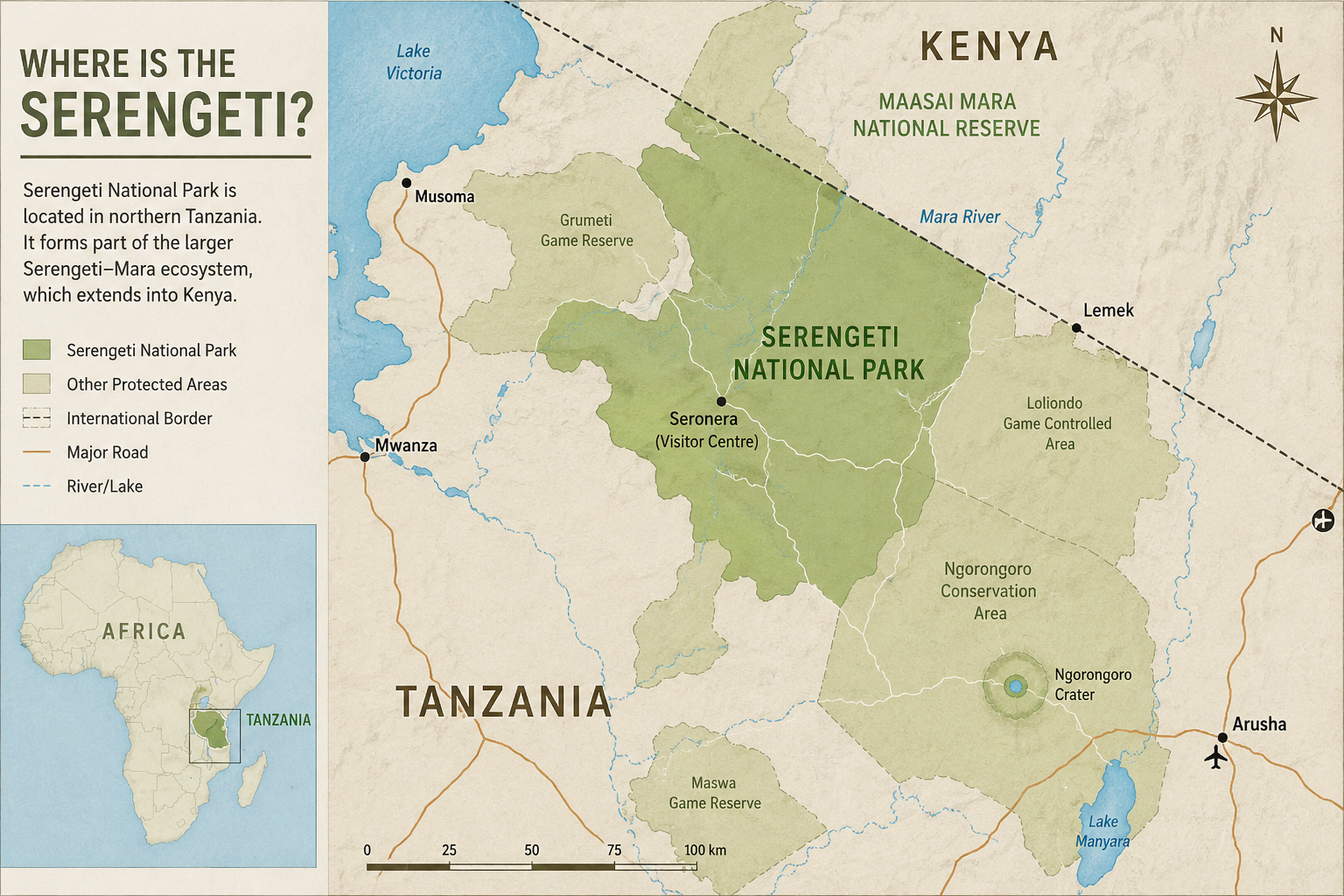
Serengeti National Park lies in northern Tanzania, between the Ngorongoro Conservation Area and the Kenyan border.
The park is part of the wider Serengeti–Mara ecosystem, which includes surrounding conservation areas, reserves and community-managed land. Wildlife moves freely across much of this landscape, particularly during the Great Migration.
The word Serengeti is commonly linked to the Maasai expression for “endless plains,” which becomes easy to understand once you arrive. In some areas, the grasslands appear to continue uninterrupted all the way to the horizon.
The park is enormous, and its different regions offer noticeably different landscapes and wildlife experiences. Choosing where to stay is therefore just as important as deciding when to visit.
What makes the Serengeti special?
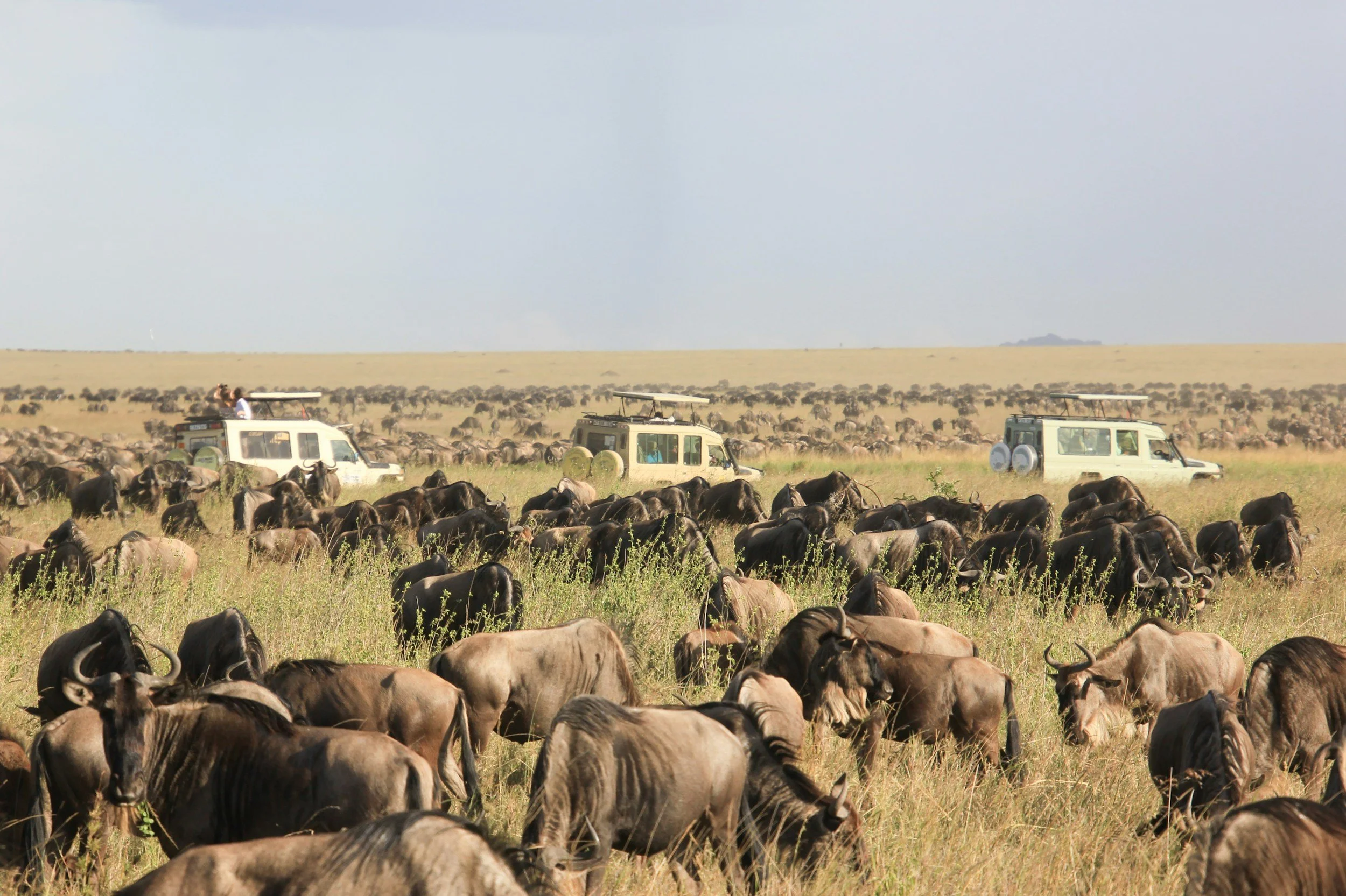
The Great Migration is the Serengeti’s most famous attraction, but it is only one part of the ecosystem.
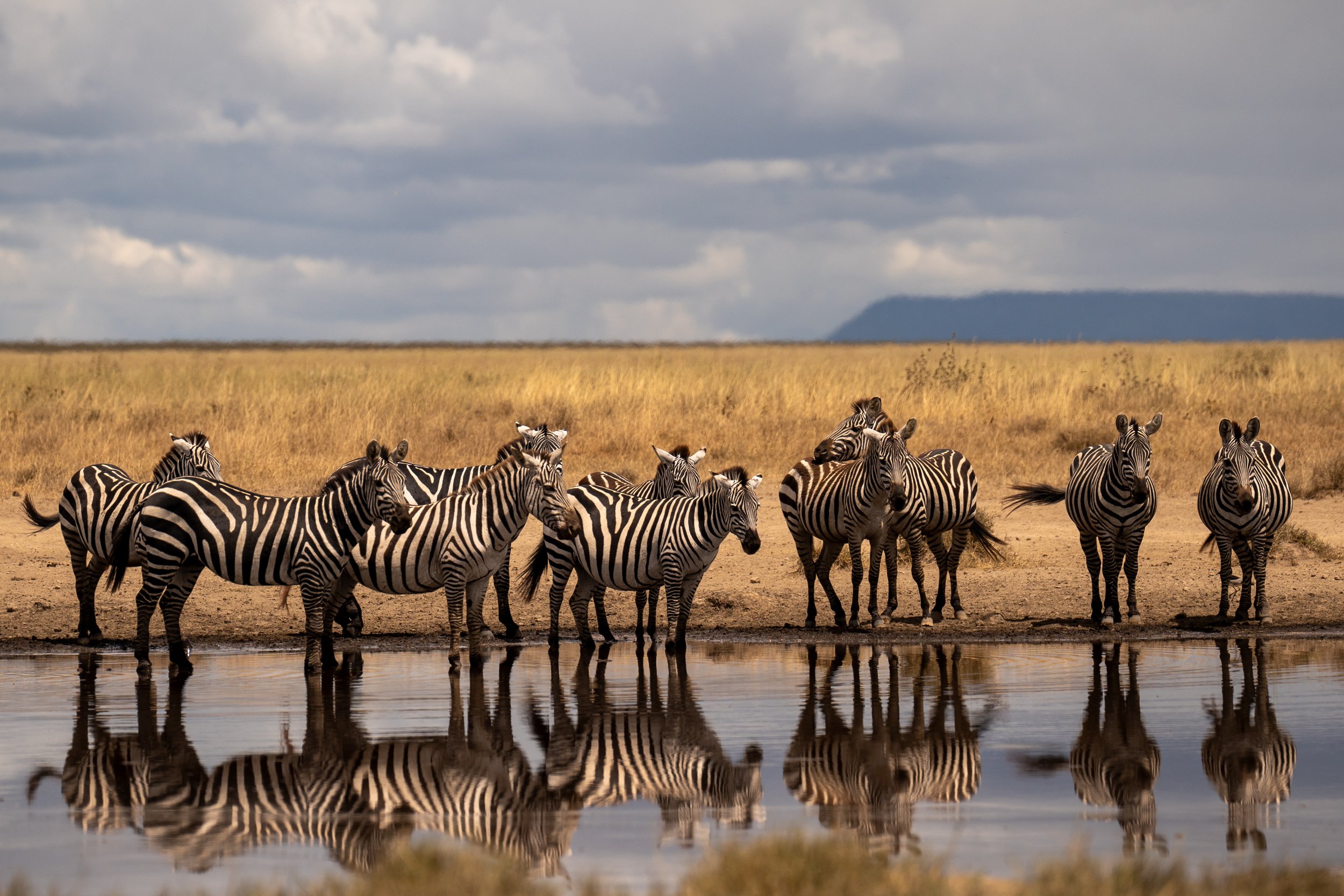
The park has strong populations of resident predators and herbivores throughout the year. Even when the migratory herds are in another region, you can still encounter lions, leopards, cheetahs, elephants, giraffes, buffalo, hippos, hyenas and numerous antelope species.
UNESCO records very high biological diversity within the park and notes the presence of globally threatened species including black rhinoceros, elephants, wild dogs and cheetahs.
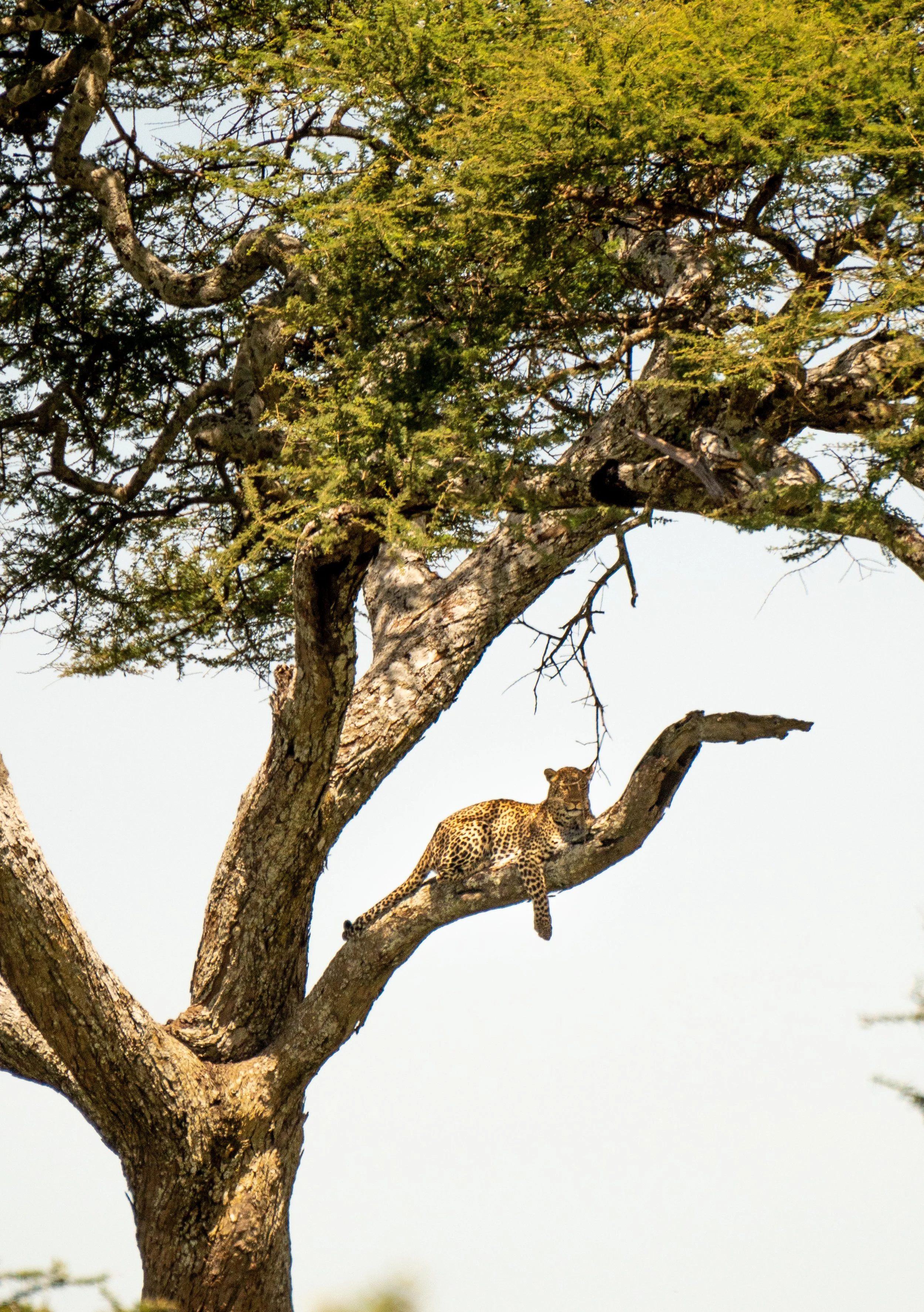
What makes the Serengeti particularly memorable is the scale of the landscape. A sighting may involve a single leopard resting in a tree, but it may also involve hundreds of animals spread across an open plain.
There is a constant sense that something could appear at any moment.
When is the best time to visit the Serengeti?
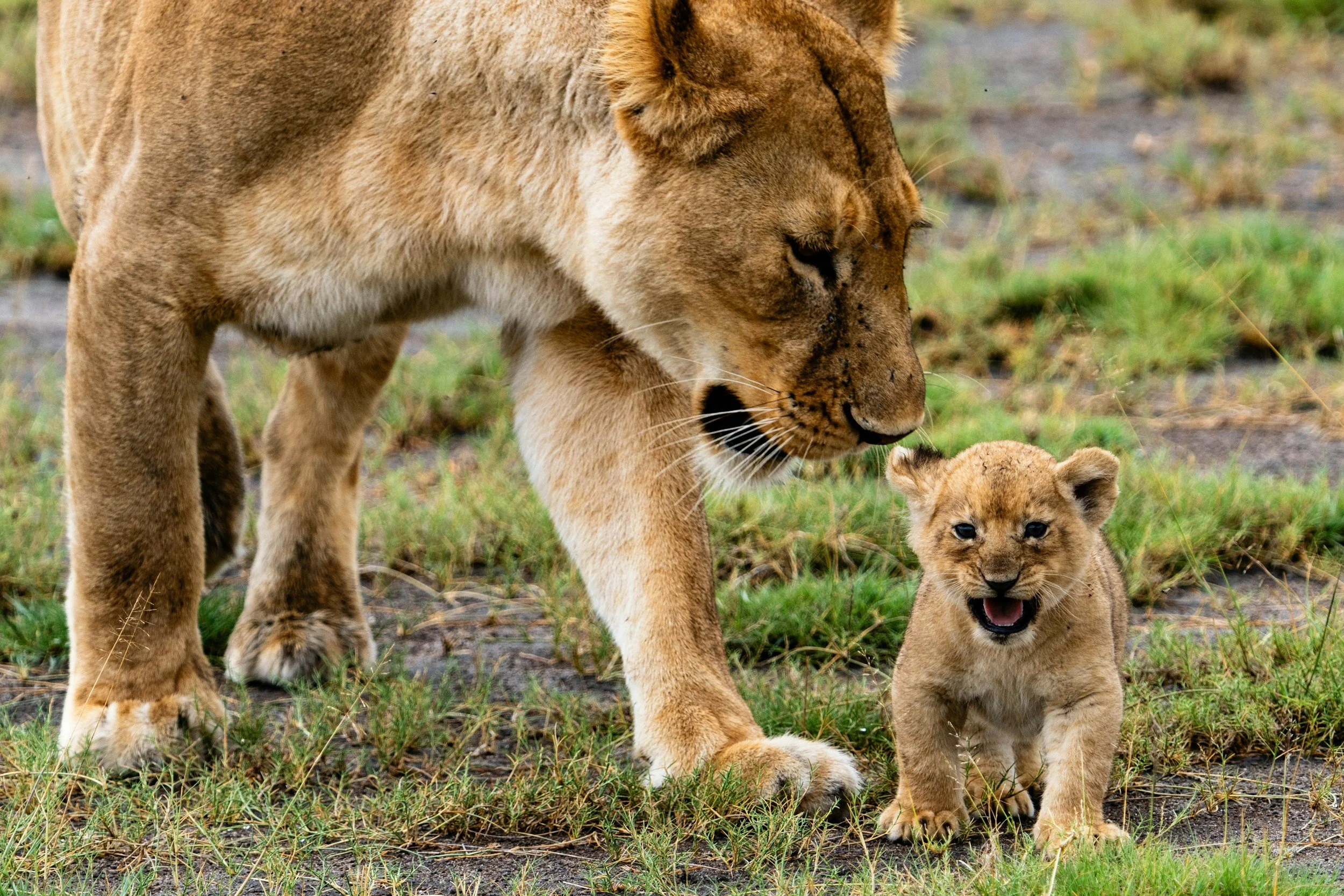
There is no single bad time to visit the Serengeti. Wildlife remains in the park throughout the year, but the weather, scenery, visitor numbers and location of the migration change with the seasons.
The best time to travel therefore depends on what you most want to experience.
January to March: Calving season
At the beginning of the year, large sections of the Great Migration gather on the short-grass plains of the southern Serengeti and the neighbouring Ndutu region.
This is calving season, when huge numbers of wildebeest give birth within a relatively concentrated period. The plains are often green after the seasonal rains, and the abundance of young animals attracts lions, cheetahs, hyenas and other predators.
January through March is particularly good for:
Newborn wildebeest and predator activity
Green landscapes
Wildlife photography
Large herds on open plains
Warm weather with occasional rain
Calving season can be dramatic, but not every game drive involves a hunt. Much of the experience is simply watching mothers and calves moving across the grasslands while predators wait nearby.
Entara’s Esirai Camp operates in the southern Serengeti during this part of the migration cycle, placing guests close to the short-grass plains rather than requiring long drives from a permanent camp elsewhere in the park.
April and May: Green season
The Serengeti becomes greener, storm clouds build over the plains and visitor numbers tend to be lower. Roads can become muddy, some remote routes may be more difficult to navigate and certain mobile camps temporarily close or move.
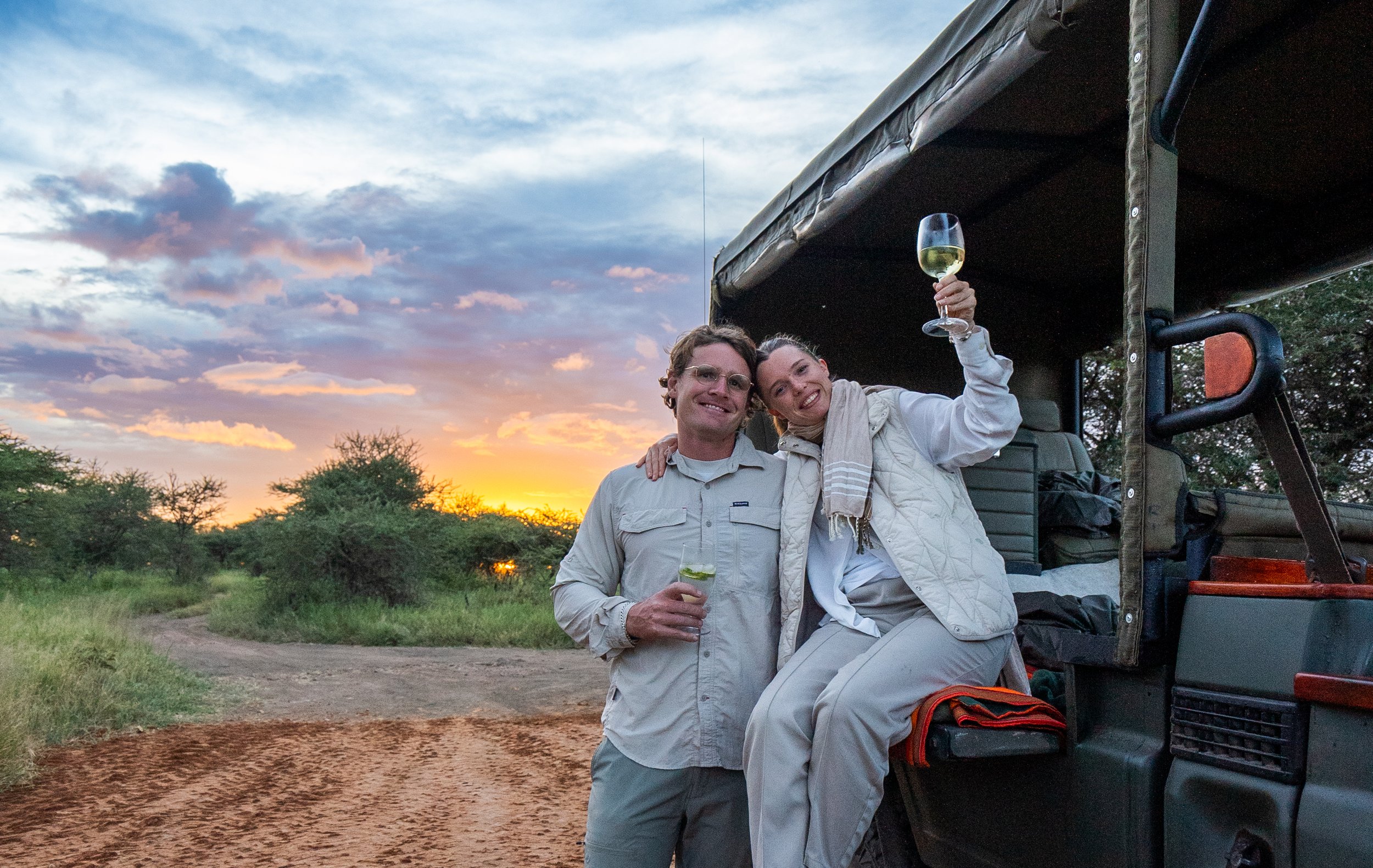
However, this can be a beautiful and peaceful time to travel. The park feels quieter, the light can be excellent for photography and rates may be lower than during the busiest months. This is the period in which we visited, and honestly, as South Africans who love private safaris, we enjoyed the lack of crowds we had during our time in the Serengeti.
Travellers who value solitude (like us) and do not mind occasional weather disruptions may find this one of the most rewarding periods.
June: Transition into the dry season
By June, the longer rains are normally ending and the landscape gradually begins to dry.
Migratory herds may be moving through the western and central areas of the ecosystem, although their exact position varies according to rainfall. Wildebeest rutting activity can also continue through this period, bringing noisy displays, competition and movement across the plains. Entara identifies roughly May to July as an important period for the wildebeest rut.
June often provides a good balance between comfortable weather, strong wildlife viewing and slightly smaller crowds than the peak months that follow.
July to October: Dry season and northern migration
July to October is one of the most popular periods for visiting the Serengeti.
The weather is generally dry, vegetation becomes thinner and animals gather around dependable water sources. This can make wildlife easier to locate, although it also means dustier conditions and larger numbers of safari vehicles in popular areas.
During these months, many of the migratory herds move into the northern Serengeti. This is the main period associated with the Mara River crossings, when wildebeest may enter the crocodile-filled river while moving between Tanzania and Kenya.
Crossings are completely unpredictable. Herds may wait near the river for days, begin moving towards the water and then turn around. No guide or camp can guarantee that you will witness one.
Even without a crossing, the northern Serengeti offers beautiful scenery, large herds and excellent general wildlife viewing.
Entara’s Esirai Camp relocates north to provide access to the wider Mara River region while maintaining the character of a small, low-impact mobile camp.
November and December: Short rains and the return south
The short rains usually begin around November, encouraging new grass growth.
The migratory herds gradually begin moving south through the eastern and central Serengeti. Their route and timing vary each year, so this period is harder to predict than the more established calving and northern seasons.
The return of rain transforms the landscape, reduces dust and often brings dramatic skies. Visitor numbers can also fall after the peak northern season.
November and early December can be excellent for travellers who want good resident wildlife, changing landscapes and fewer vehicles without visiting during the heavier rains.
Understanding the different areas of the Serengeti
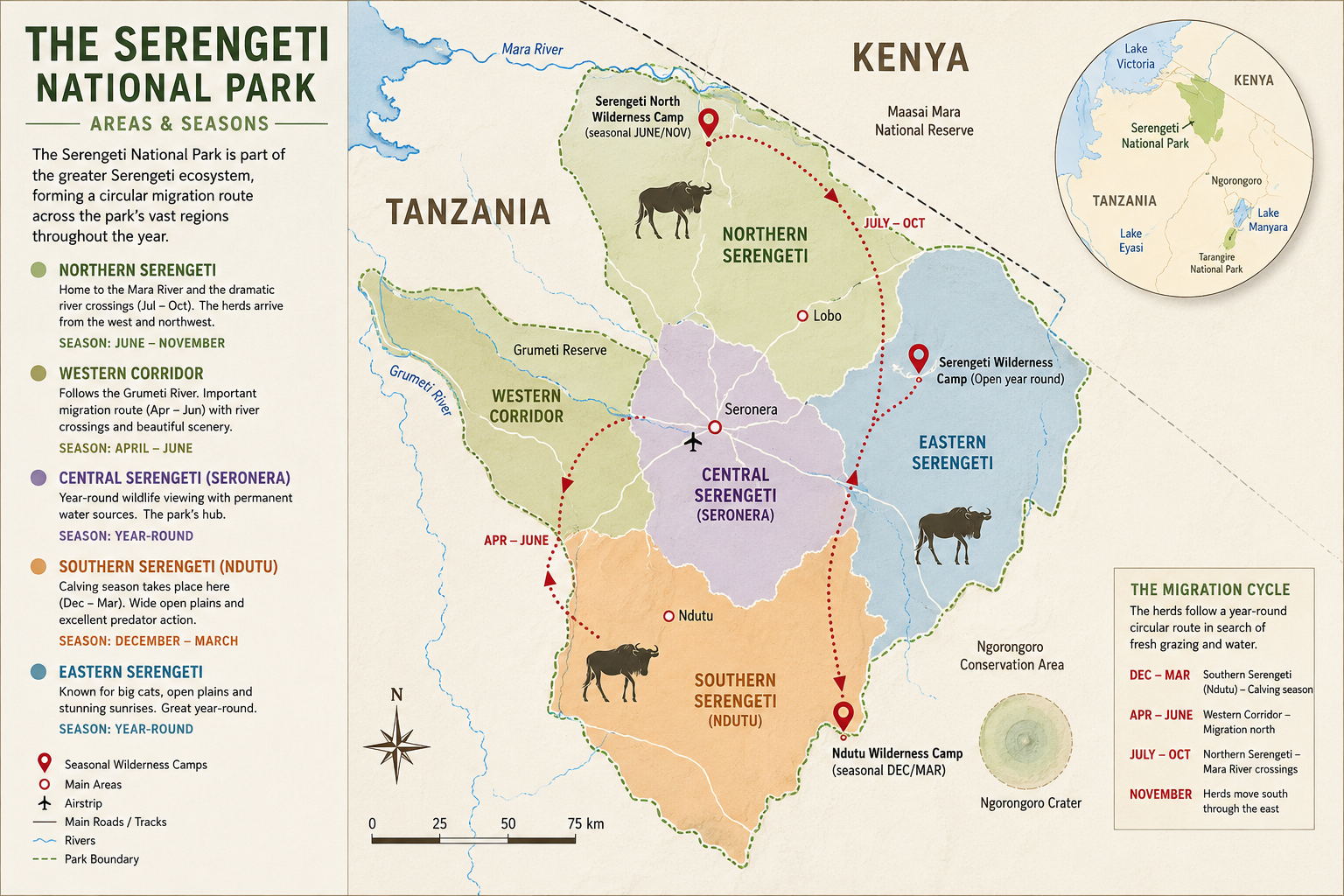
The Serengeti is far too large to treat as one single safari area. Driving between regions can take several hours, especially when wildlife sightings or rough roads slow the journey.
Central Serengeti
The central Serengeti, often referred to as Seronera, is one of the most reliable areas for wildlife throughout the year.
Permanent water sources support resident animals, including lions, leopards, elephants, giraffes and hippos. Its central location also makes it an important transport hub, with an airstrip and road connections to other parts of the park.
The trade-off is that central Serengeti can become busy. Several lodges and camps operate in the area, and popular sightings may attract many vehicles.
It is a useful region for first-time visitors or shorter trips, but travellers seeking greater isolation may prefer the east or north.
Eastern Serengeti
This is the part we focused on, while staying at Entaras Olmara Camp. The eastern Serengeti offers wide grasslands, rocky outcrops and a more remote atmosphere.
This region is particularly well known for cheetahs and other big cats, which use the open plains for hunting. It generally feels quieter than central Serengeti, making it an excellent choice for photographers and travellers who prefer fewer vehicles.
Entara’s Olmara Camp is located in the eastern Serengeti’s Soit Le Motonyi region, an area associated with strong lion and cheetah viewing.
Southern Serengeti
The southern plains become the centre of migration activity during the early months of the year.
The open short-grass landscape makes it easier to see enormous herds, newborn calves and predators from a distance. This region is especially rewarding from approximately December to March, although precise conditions depend on rainfall.
Northern Serengeti
The north is more varied than the classic image of completely open plains.
Here, grasslands are broken by hills, woodland and the Mara River. Wildlife viewing remains excellent, and the landscape can feel more rugged and remote than central Serengeti.
It is the main region for travellers hoping to witness migration crossings between approximately July and October.
Western Corridor
The Western Corridor follows the Grumeti River and includes woodland, open plains and riverine habitat.
Migratory herds often move through this region during the middle part of the year. Grumeti River crossings may occur, although they tend to receive less attention than crossings in the north.
Where to stay in the Serengeti
Your accommodation should be chosen according to the season and the part of the Serengeti you want to explore.
A lodge may technically be inside or close to the national park while still being several hours from the wildlife activity you came to see. For a migration-focused safari, location matters more than almost anything else.
Olmara Camp: Remote eastern Serengeti
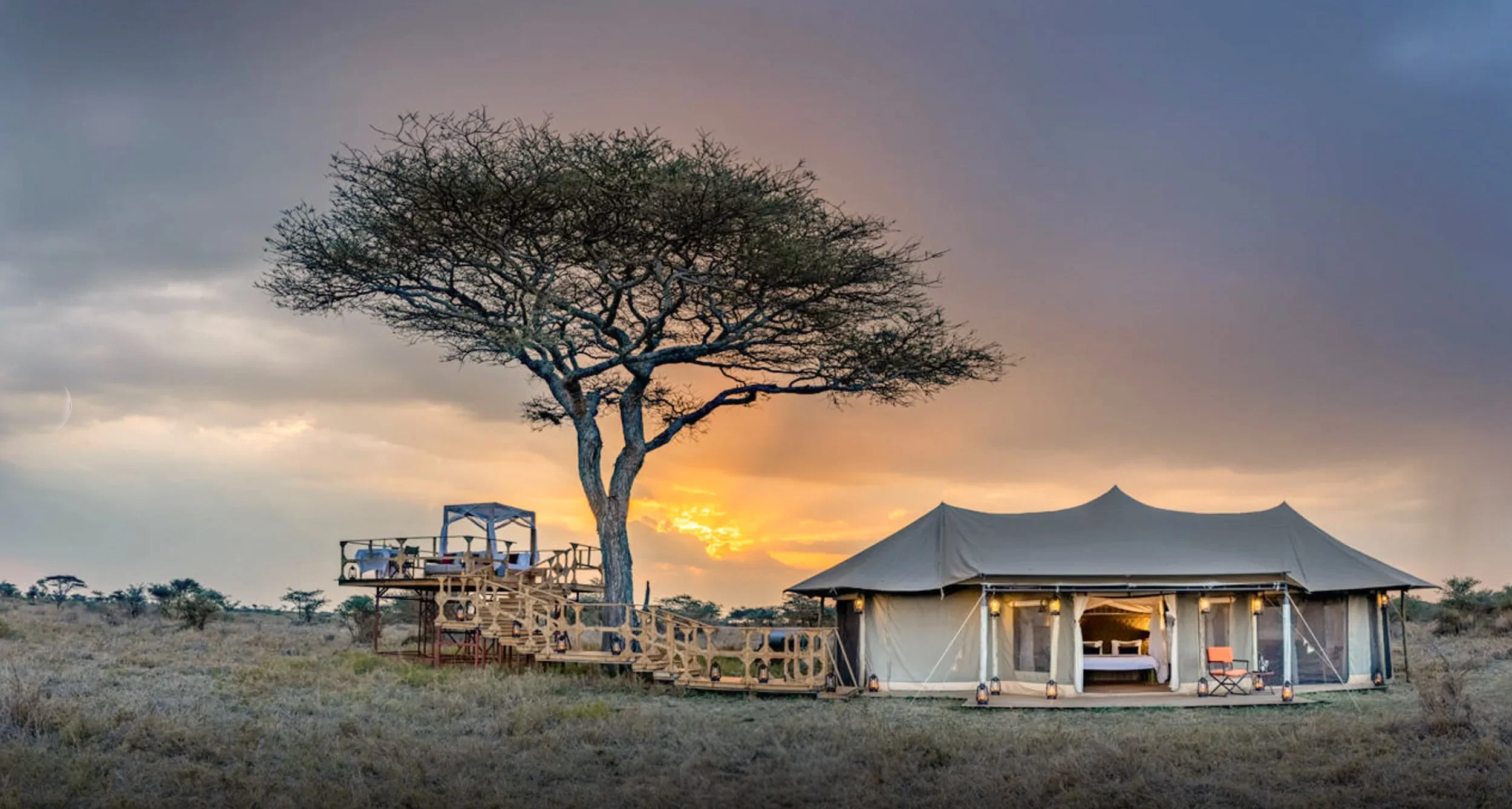
Olmara Camp is Entara’s intimate tented camp in the eastern Serengeti.
It has eight guest tents: five tented suites and three Stargazer suites. The tents are positioned among acacias, with views across the grasslands and the Ngare Nanyuki river valley.
The camp is particularly suited to travellers looking for:
Big-cat sightings
Wildlife photography
A remote atmosphere
Walking and fly-camping experiences
Fewer vehicles than central Serengeti
A more immersive stay beneath canvas
Olmara offers game drives, walking safaris, fly camping, bush meals, stargazing beds and the option of arranging a hot-air-balloon flight.
One of the defining parts of staying here is how exposed you feel to the surrounding wilderness. Animals can move through the wider camp area, and at night you may hear lions, hyenas or other wildlife beyond the canvas.
The tents remain comfortable, but the experience never feels separated from the Serengeti.
Esirai Camp: Following the Great Migration
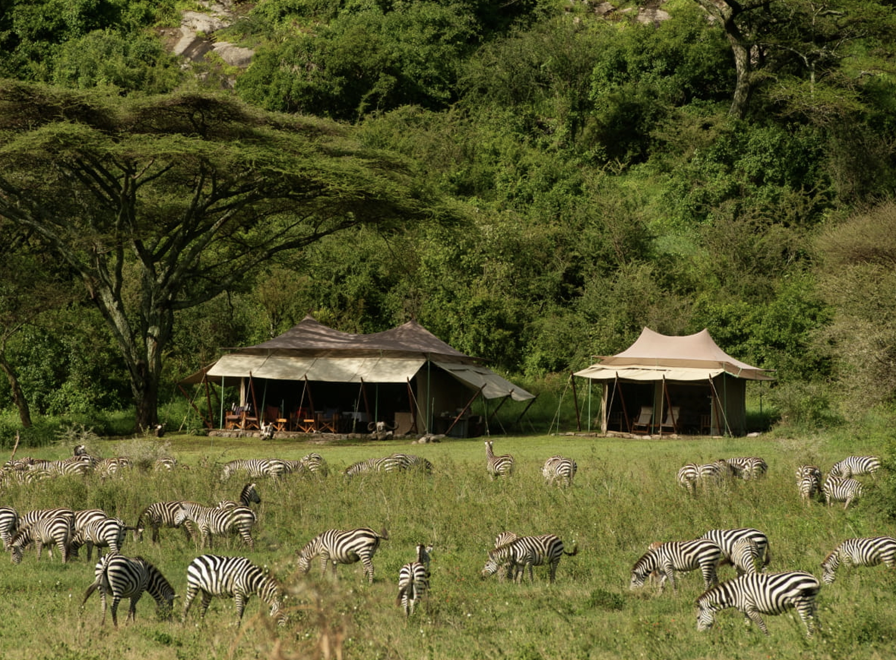
Esirai is Entara’s mobile migration camp, moving between the northern and southern Serengeti.
Rather than remaining in one permanent location, the camp relocates to follow two of the migration’s most important stages: the short-grass season and calving period in the south, followed by the northern migration and Mara River season.
The entire camp is designed to pack into a single vehicle. Entara states that the camp moves approximately 180 kilometres twice a year and can be dismantled, transported and rebuilt by a 12-person team in about seven days.
Esirai has eight tents and maintains a classic mobile-safari feeling while still providing proper beds, bathrooms, meals and a communal mess area.
This is a particularly good option for travellers whose main priority is the Great Migration. Staying close to the expected herd location reduces daily driving and gives guides more flexibility when responding to changing wildlife movements.
Combining Entara’s camps
A strong Serengeti itinerary does not have to focus only on the migration.
Combining Esirai with Olmara allows you to experience two distinct sides of the park. Esirai places you closer to the seasonal movement of the herds, while Olmara provides access to the quieter eastern grasslands and their resident predators.
Beyond the Serengeti, Entara also operates camps in other parts of northern Tanzania, including Olkeri Camp near Tarangire, Koroi Forest Camp near Arusha National Park and Kisima Ngeda on Lake Eyasi. Kisima Ngeda has eight tented chalets and provides access to cultural and wilderness experiences around the lake.
This makes it possible to create a broader itinerary that includes elephants in Tarangire, the Serengeti’s big cats, the Great Migration and time with communities around Lake Eyasi.
What to expect from a Serengeti safari
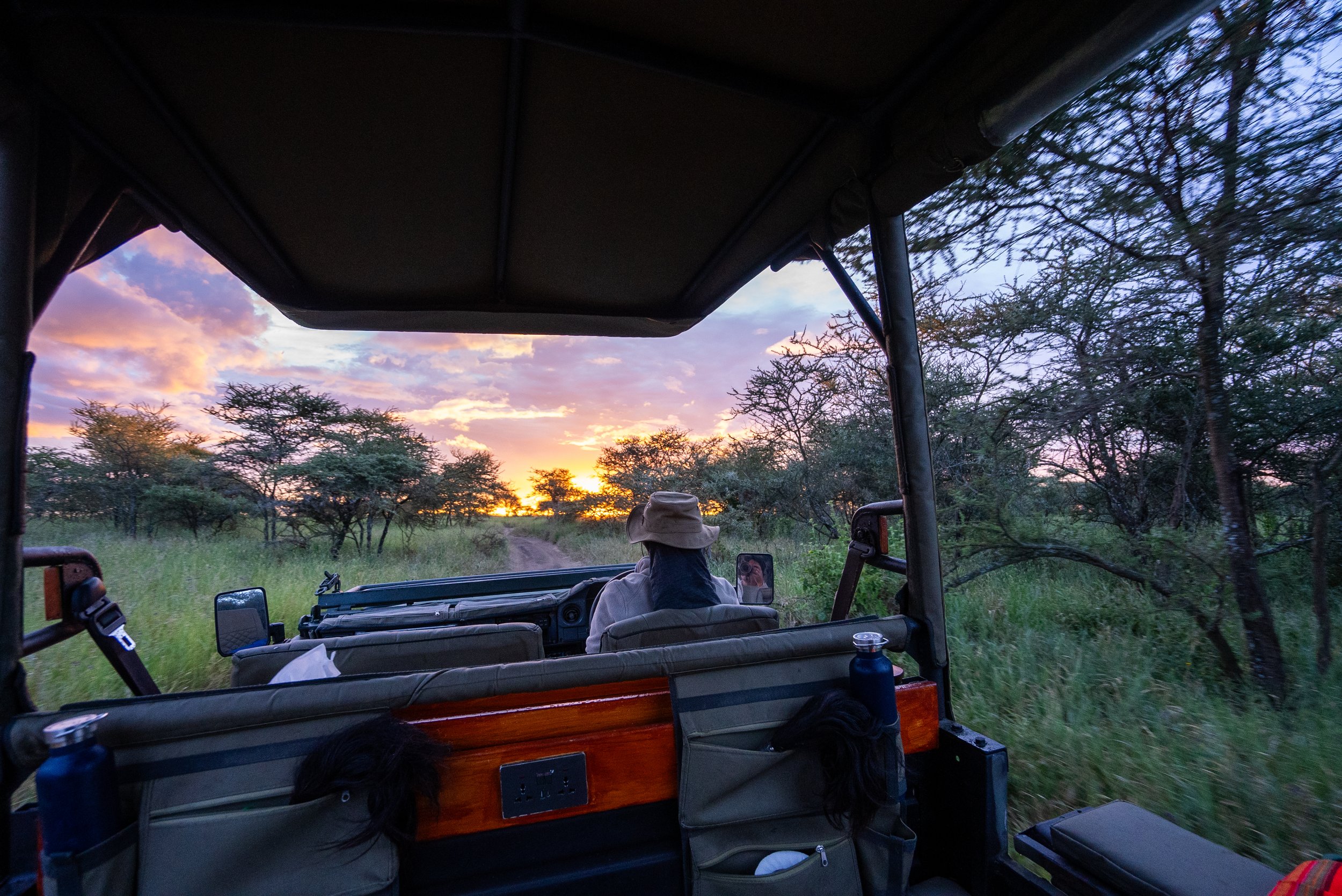
Early mornings
Safari days often begin around sunrise.
Morning temperatures can be surprisingly cold, particularly in an open vehicle. Wildlife is generally more active before the heat of the day, so early starts give you a better chance of seeing predators moving or hunting.
Depending on your itinerary, you may return to camp for breakfast and lunch or remain out for a full-day game drive with a packed meal.
Long and rough drives
The Serengeti is enormous, and roads are mostly unpaved.
Game drives can involve several hours in the vehicle, with dust in the dry season and mud during wetter months. Distances that appear short on a map may take much longer than expected.
A well-positioned camp significantly reduces unnecessary driving.
Wildlife without guarantees
The Serengeti is wild, not staged.
Guides use their knowledge of animal behaviour, recent sightings, tracks and communication with other guides, but no specific animal or event can be guaranteed.
You may spend an hour searching for a leopard and find nothing, only to turn a corner and discover a pride of lions beside the road.
This unpredictability is a large part of what makes safari so exciting.
Animals near camp
Many Serengeti camps are unfenced.
Wildlife may pass between the tents, particularly after dark. Guests are generally escorted to and from their rooms at night and must follow the instructions provided by camp staff.
Hearing animals outside can feel intimidating at first, but it is also one of the most memorable aspects of staying in a tented camp.
Limited connectivity
Internet availability varies between camps.
Wi-Fi may work well in communal areas but remain unavailable inside tents. Esirai is intentionally more off-grid and does not currently provide guest Wi-Fi, according to Entara’s published FAQs.
It is best to treat connectivity as a bonus rather than something on which to rely.
How many days do you need in the Serengeti?
Three nights should be considered a practical minimum, but four or five nights will give you a better experience.
The park is too large to understand properly during a rushed overnight stop. More time allows you to explore at a slower pace, remain with interesting sightings and recover from the long journey required to reach the park.
For a broader northern Tanzania safari, seven to twelve days works well. A typical route could combine:
Arusha or Arusha National Park
Tarangire or Randilen Wildlife Management Area
Lake Eyasi
Ngorongoro
Eastern, central, southern or northern Serengeti
Travellers focused on migration should spend at least three nights in the region where the herds are expected to be.
Driving or flying into the Serengeti
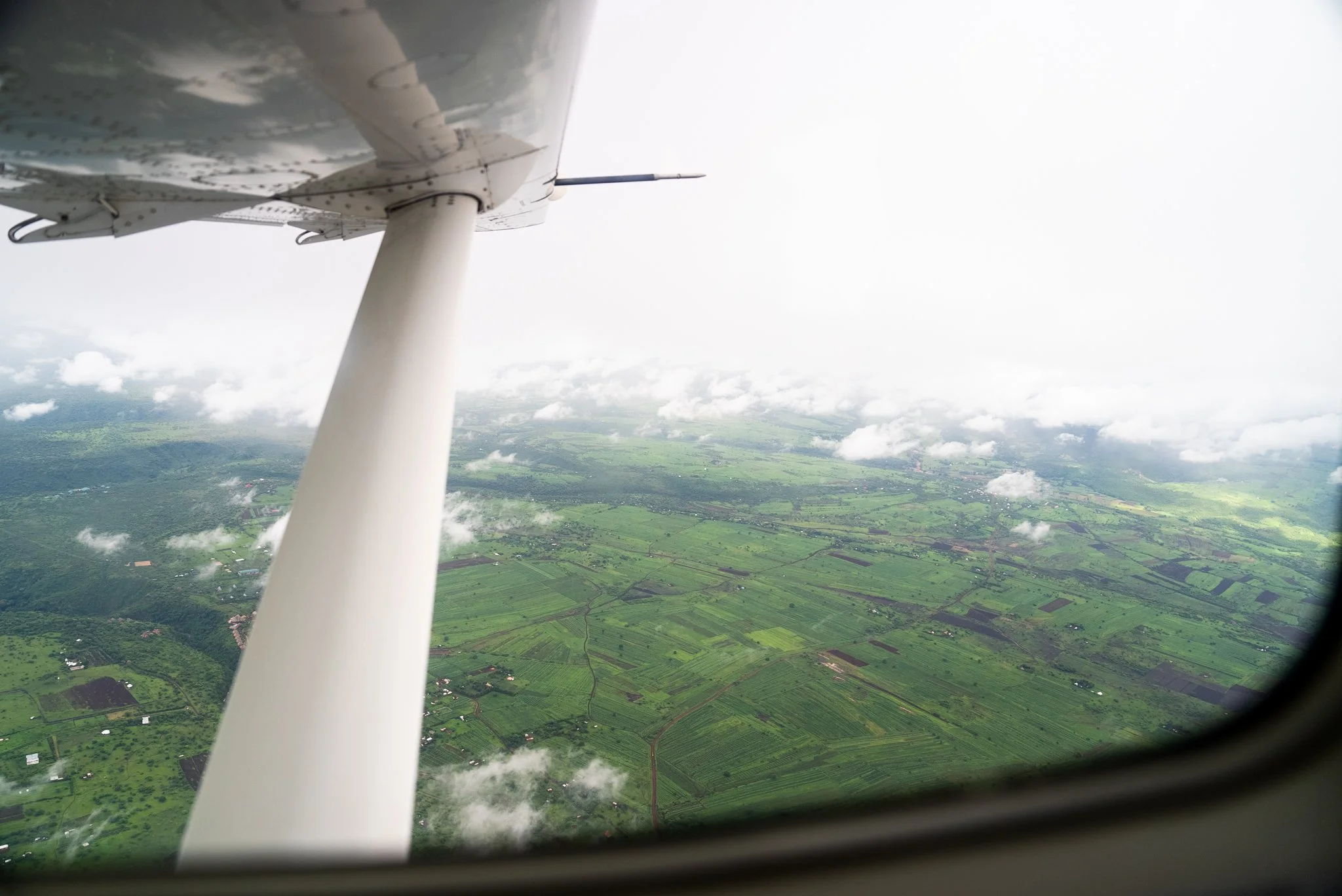
You can reach the Serengeti by road or light aircraft.
Driving from Arusha allows you to pass through other parts of northern Tanzania, such as Lake Manyara, Ngorongoro and Tarangire. It can be an interesting journey, but travel times are long and roads become rough.
Flying is faster and gives you more time on safari. Small aircraft connect Arusha and other safari regions with airstrips such as Seronera and Kogatende.
Luggage limits are usually stricter on light aircraft, and soft-sided bags are generally more practical than hard suitcases. Your safari planner or camp should confirm the current limits for your specific flight.
A combination often works best: travel overland through part of the northern circuit and fly back from the Serengeti.
What to pack for the Serengeti
Bring practical layers rather than overly specialised safari clothing.
Mornings may be cold, afternoons can become hot and dust gets into almost everything. Neutral colours are useful, but you do not need to dress entirely in khaki.
Pack a warm jacket, lightweight clothing, a hat, sunscreen, sunglasses, comfortable closed shoes and a small day bag. Binoculars are extremely useful even when your guide carries a pair.
For photography, a telephoto lens will make a major difference. Bring more memory cards and batteries than you think you need, along with a dust cloth or basic cleaning kit.
Avoid packing only for hot weather. Early game drives can feel very cold before the sun rises.
Planning a more sustainable Serengeti safari
The Serengeti is a protected ecosystem under significant environmental pressure. Responsible travel involves more than simply visiting a national park.
Choose camps that limit permanent infrastructure, manage waste and water carefully, employ and train Tanzanian staff and operate with respect for wildlife and neighbouring communities.
Entara’s Esirai Camp is a particularly clear example of a lighter-footprint approach. Its mobile design allows the camp to move with the seasons and be removed without leaving behind the type of permanent development associated with a fixed lodge.
Guests also have a role to play. Follow park rules, never ask a guide to drive off-road where it is prohibited, avoid pressuring wildlife and do not encourage overcrowding around sightings.
Planning your Tanzania trip with Viatu
Organising a Serengeti safari is more complicated than booking an ordinary holiday.
You need to coordinate camp locations, seasonal wildlife movements, park fees, internal flights, road transfers and the number of nights spent in each area. A poorly planned itinerary can leave you spending most of the trip in transit or staying far from the wildlife you hoped to see.
Viatu creates tailor-made trips around the traveller’s interests, preferred style of accommodation and the experiences they genuinely care about. Its Tanzania portfolio includes custom safari itineraries as well as journeys combining the Serengeti with other northern-circuit destinations or Zanzibar.
Viatu is also a certified B Corporation. This means its social and environmental performance has been assessed as part of the B Corp certification process, rather than its sustainability claims relying only on its own marketing.
For our Tanzania journey, Viatu coordinated the accommodation, transfers, local guides and overall route while carefully selecting partners such as Entara. You can view our Tanzanian itinerary here.
For travellers trying to plan a Serengeti safari responsibly, Viatu is our recommended agency for connecting the different pieces into one manageable itinerary.
Is the Serengeti worth visiting?
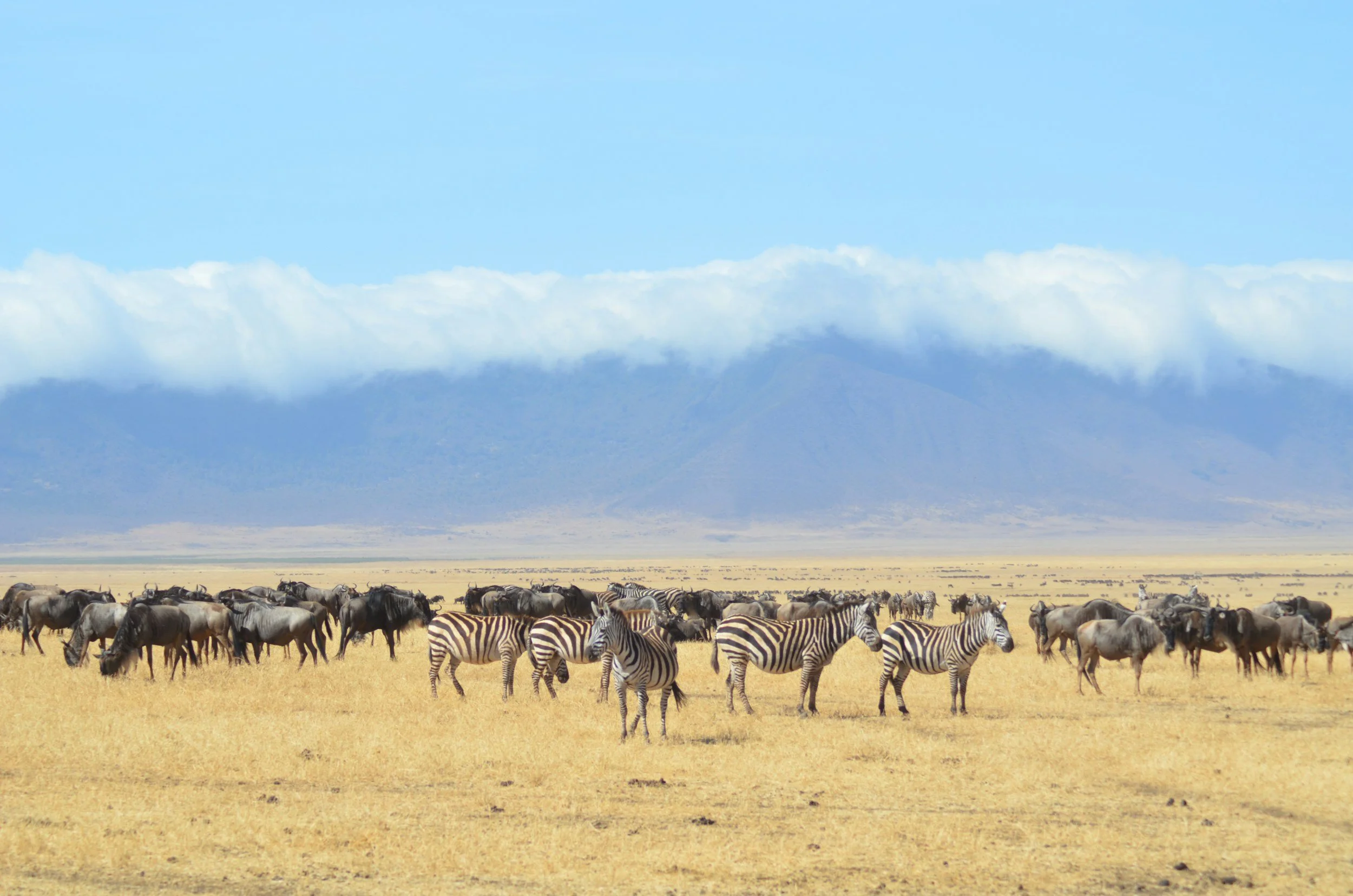
Yes—without question.
The Great Migration alone makes this one of the most important wildlife areas in the world, but the Serengeti remains remarkable even when the main herds are elsewhere.
Its real strength lies in the combination of scale, wildlife density and unpredictability. You may watch a leopard hunting across an open plain, find lions sleeping on a kopje or wake during the night to the sound of animals moving past your tent.
The Serengeti is not always comfortable or convenient. Drives are long, roads are rough and sightings cannot be scheduled.
But that is precisely why it feels so different from almost anywhere else.
By choosing the right region, allowing enough time and staying somewhere that keeps you connected to the landscape, the Serengeti becomes more than a place to tick off a list. It becomes one of those rare travel experiences that is even more powerful than you imagined.
Serengeti FAQs
What is the best month to visit the Serengeti?
July to October is best for dry conditions and the possibility of Mara River crossings in the north. January to March is best for the southern calving season. June, November and early December can offer excellent wildlife with fewer visitors.
Can you see wildlife throughout the year?
Yes. The migration moves seasonally, but lions, leopards, cheetahs, elephants, giraffes, buffalo and many other animals remain within the wider ecosystem throughout the year.
Are migration river crossings guaranteed?
No. Crossings are completely unpredictable. Spending several nights in the northern Serengeti improves your chances, but no ethical operator should promise a crossing.
Is the Serengeti crowded?
Some areas can be, particularly central Serengeti and popular Mara River points during peak season. Staying in quieter regions such as eastern Serengeti can provide a more isolated experience.
Where should you stay for the migration?
Choose a camp based on the season rather than selecting one permanent location for every month. Entara’s Esirai Camp moves between the southern and northern Serengeti to remain closer to the migration during key parts of the year.
Where should you stay for big cats?
The central Serengeti has reliable year-round predator viewing, while the eastern Serengeti is particularly well known for lions and cheetahs. Entara’s Olmara Camp provides a remote base in this eastern region.
How long should you stay?
Spend at least three nights in the Serengeti. Four or five nights is better, particularly when dividing your time between different regions.
Who should plan the trip?
Viatu can coordinate a tailor-made Tanzania itinerary using carefully selected local partners, including Entara. Its B Corp certification also makes it a strong choice for travellers looking for a more considered and sustainable approach.